🌸《Five Japanese Words from the World of Floral Design: Adding Fragrance to Your Learning Journey》

🌿 Introduction
Every time I study Japanese, I enjoy connecting it with my love of floral design.
This allows language to become more than just something to study—it becomes something to experience.
Today, I would like to share five of my favourite Japanese words related to floral design.
I hope that, after learning them, you too will be able to sense a gentle fragrance within the language.
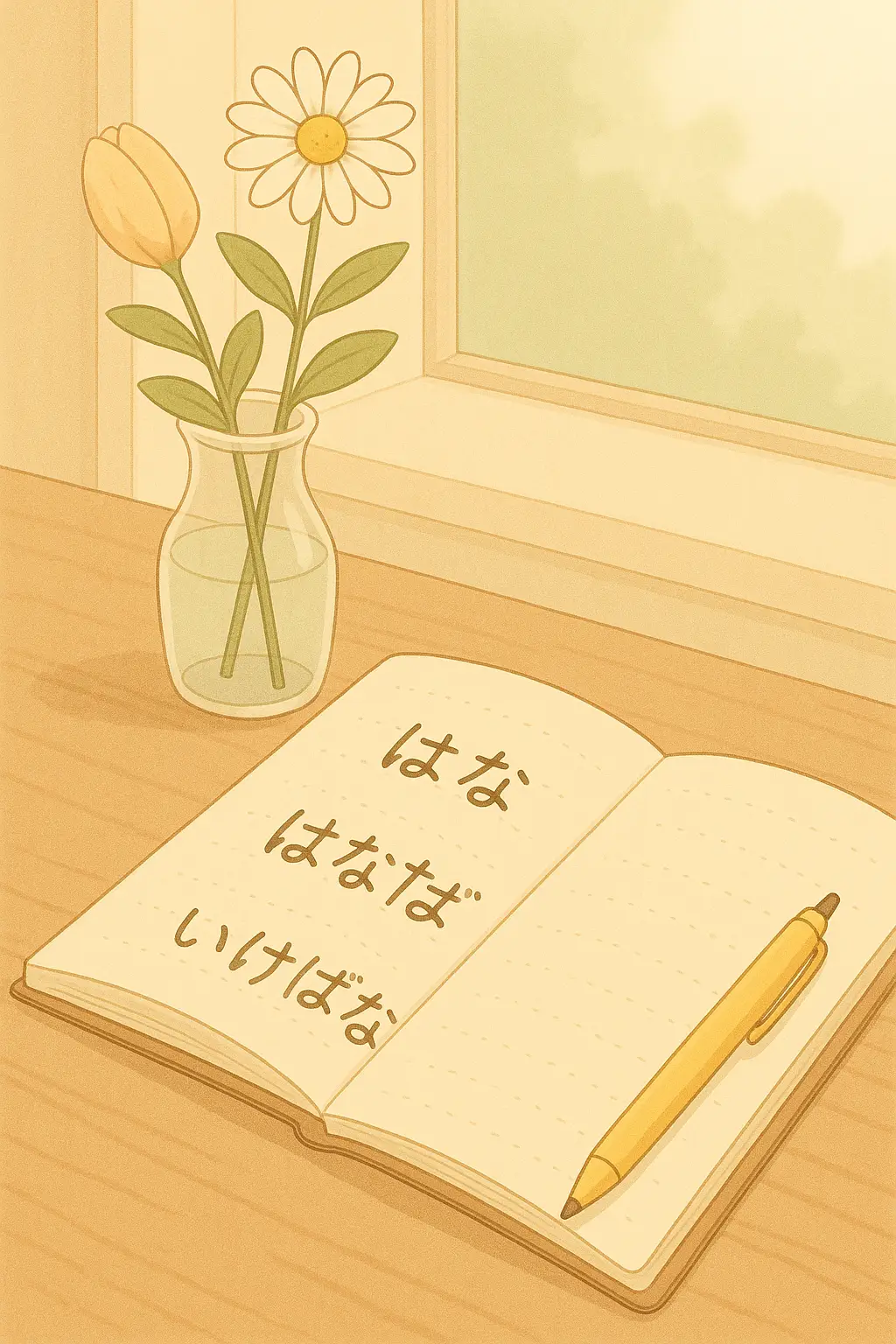
🌼 1. Flower(はな hana)
This is one of the simplest and gentlest Japanese words. Flowers are more than part of nature.
To me, they are a source of comfort, inspiration, and everyday happiness.
Whether it is a rose, a lily, or a little daisy, every flower has a story to tell.
Exampleきれいな花をかざります。
I decorate the room with beautiful flowers.
🌷 2. Bouquet(はなたば hanataba)
A bouquet represents heartfelt feelings.
Whether it is for celebration, gratitude, or appreciation, a bouquet can express more than words ever could.
Whenever I create a bouquet, I quietly imagine the smile on the recipient's face.
Example:友だちに花束をおくりました。
I gave my friend a bouquet of flowers.
🍃 3. Leaf(葉っぱ happa)
As I learned floral design, I gradually realised that leaves are just as important as flowers.
They provide support, balance, and a natural backdrop that allows every flower to shine.
In the same way, the small details in language are what bring a sentence to life.
Example:この葉っぱのかたちはおもしろいですね。
The shape of this leaf is very interesting.
💧 4. Mizukiri(みずきり mizukiri)
When I first encountered ikebana, I was deeply drawn to its quiet beauty.
It is not simply about arranging flowers—it is about giving life to them.
I hope we can approach language learning in the same way:
not merely to memorise words, but to let them come alive within our hearts.
Example:花をいける前に、水切りをします。
My mother is an ikebana teacher.
🎍 5. Ikebana(生け花 いけばな ikebana)
Ikebana is not only an art form—it is also a philosophy of life.
When I first discovered ikebana, I was captivated by its unique beauty.
It is not simply about arranging flowers; it is about breathing life into them.
I hope we can approach language learning with the same spirit—
not merely memorising words,
but allowing them to come alive within our hearts.
Example:母は生け花の先生です。
My mother is an ikebana teacher.
✨ Conclusion
Language and floral design are not so different.
Every word, like every flower, has its own beauty and purpose.
When we learn with care and observe with our hearts, we can discover beauty in everyday life.
These five words are among the fragrances I treasure most in my daily life.
Perhaps they will become part of your journey as well.